
Choosing a built-in wood fireplace: efficiency, combustion and fitting
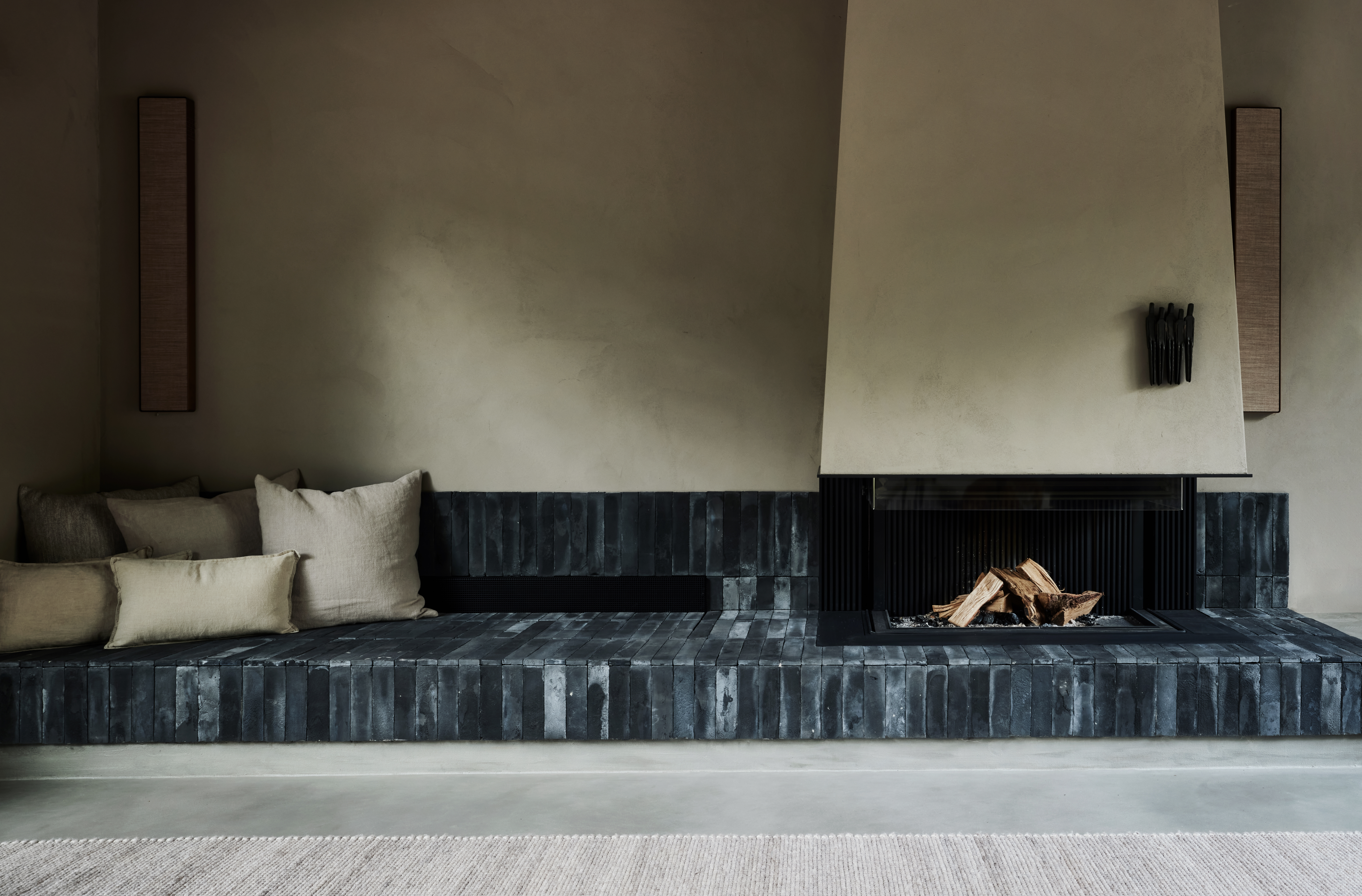
Metalfire is known for architectural fire: clean lines, seamless integration and fireplaces that blend into the interior. But behind that design story is, first and foremost, a manufacturer. Since 2003 we have designed and produced our wood fireplaces entirely in our own workshop in Evergem, from engineering to finish. A Metalfire wood fireplace is therefore not just a beautiful object in a room, but a technical appliance developed to burn efficiently, reliably and with low emissions.
Anyone choosing a built-in wood fireplace today is really making three choices at once. How high is the appliance’s efficiency? How clean and complete is the combustion? And how is the fireplace fitted and integrated into the home? These three elements, efficiency, combustion and fitting, together determine how well a wood fireplace performs and how pleasant it is in daily use.
In this guide we work through those three pillars one by one, each time from the practice of a manufacturer that develops its own appliances. As a starting point we take the closed wood fireplaces of the Ultime D range, which comply with the European Ecodesign 2022 standards. This makes clear why a quality built-in wood fireplace is today an efficient heating solution that meets the current European requirements for efficiency and emissions, and where Metalfire makes the difference.
In short
- A closed built-in wood fireplace is a high-efficiency appliance. The choice comes down to three things: efficiency, combustion and fitting.
- Efficiency: a closed built-in appliance achieves a far higher efficiency than an open fire, because the air supply and heat output are controlled. Most models in Metalfire’s closed Ultime D range carry energy label A+, the others label A.
- Combustion: a dynamic combustion technique ensures more complete and cleaner combustion with lower emissions. The Ultime D range complies with Ecodesign 2022, with emissions within the European limits.
- Fitting: a correct flue, a sufficient air supply and, in an airtight low-energy or passive home, a correctly connected external air supply are decisive. The Ultime D is designed as a room-sealed appliance as standard for that purpose. The fitting itself is carried out by the approved Metalfire dealer.
- Built-in or bespoke: the built-in wood fireplaces form the basis. Anyone seeking more architectural freedom can have the Ultime D integrated into a bespoke design: finishing frames, fireplace concepts and log storage made to measure, around the same certified appliance. For a fully bespoke wood fireplace, with a spark screen, there is the Universal.
Why the manufacturer makes the difference
Metalfire is often associated with design and architecture. That is true, but it tells only part of the story. At its core, Metalfire is a manufacturer of gas and wood fireplaces, with its own production site, its own engineering department and its own R&D team. That combination determines the quality of every appliance, and certainly that of our wood fireplaces.
An in-house wood fireplace range: Ultime D
Our main range of closed wood fireplaces is the Ultime D. These are built-in appliances with a closed firebox and a lift door: a glass door that slides upwards to light the fire or add wood, developed around a dynamic combustion technique (explained further under Combustion). The result is a high efficiency, a clear view of the fire and lower emissions. Most models carry energy label A+. Depending on the model, efficiency lies between 79% and 84%, with 84% for the MF 1050-50 WHE 2S and 3S.
Ecodesign 2022 as the starting point
Since 1 January 2022, Ecodesign Regulation (EU) 2015/1185 has applied across Europe to local space heaters using solid fuel. This standard sets minimum requirements for seasonal efficiency and caps the emissions of, among others, particulate matter, carbon monoxide (CO), organic gaseous compounds (OGC) and nitrogen oxides (NOx). Every wood fireplace placed on the market in the European Union today must meet these requirements. For closed appliances, that means a seasonal efficiency of at least 65% and a maximum of 40 mg/Nm³ particulate matter, 1,500 mg/Nm³ CO, 120 mg/Nm³ OGC and 200 mg/Nm³ NOx (at 13% O₂). Note: this seasonal efficiency is calculated differently from the nominal efficiency of 79 to 84% stated in the Ultime D technical datasheets. The two figures are therefore not directly comparable. Metalfire was ahead of this: the Ultime D range already met the Ecodesign 2022 standards before they came into force. For anyone choosing a wood fireplace, that means in practice an appliance that uses fuel efficiently and burns more cleanly than the generation of wood fireplaces from some twenty years ago.
Everything under one roof in Evergem
At Metalfire, design, R&D and engineering, production and quality control all take place at the same site in Evergem. This keeps the technical knowledge within the same team, and every step, from the combustion chamber to the finish of the frame, can be monitored in-house. That control over the entire process also explains the high level of finish for which Metalfire is known, including optional finishing frames in solid 10 mm steel.
Efficiency: how much heat do you get from your wood?
The efficiency of a wood fireplace indicates how much of the energy contained in the wood is actually converted into usable heat. The higher the efficiency, the more heat you get from the same amount of wood, and the less is lost up the flue. With a built-in wood fireplace, that efficiency is considerably higher than with a classic open fire.
Why a closed built-in appliance is more efficient
In an open fire, a large part of the heat escapes unused up the flue, and the air supply is barely controllable. A closed built-in wood fireplace works differently. The firebox is sealed by a glass door, so the combustion air is supplied in a controlled way. As a result, the wood burns more evenly, at a higher temperature and with less heat loss. Where an open fire often stays below twenty per cent efficiency, closed built-in appliances achieve several times that.
The efficiency of the Ultime D range
Metalfire’s closed wood fireplaces are developed to combine high efficiency with a beautiful, calm view of the fire. The dynamic combustion technique ensures that air is supplied at the right moment and in the right place, so that the gases released during combustion largely burn as well. This raises efficiency while reducing emissions at the same time. Most models carry energy label A+, and efficiency reaches 84% for the MF 1050-50 WHE 2S and 3S. The exact values differ by model and version.
Burning with the right parameters
A high-efficiency appliance only delivers its best result when it is burned correctly. Dry wood with a moisture content of no more than 15% is the most important factor; that requires 2 to 3 years of drying in a dry, ventilated place. Beech, oak and birch are the most suitable species: wet or insufficiently dried wood burns less well, gives off less heat and causes more deposits and emissions. The right amount of wood and a correct air setting also matter. In practice, we find that the efficiency of a good appliance depends strongly on how it is burned. An approved Metalfire dealer can provide the necessary advice.
Combustion: cleaner fire within the European standards
Efficiency and combustion are closely linked. More complete and cleaner combustion ensures not only more heat, but also lower emissions and fewer deposits. This is precisely where wood fireplace technology has made the biggest difference in recent years. No wood fireplace is emission-free, but the difference from older appliances is considerable.
Dynamic combustion technique
Metalfire’s modern wood fireplaces are equipped with a dynamic combustion technique. This distributes the primary, secondary and tertiary combustion air so that the wood burns more completely in several phases. The gases and fine particles released during a first combustion are largely post-combusted in a second phase. This leaves less unburned matter behind, which translates into a cleaner view of the fire, a higher efficiency and lower emissions.
Lower emissions of particulate matter and gases
Because combustion is more complete, less particulate matter and fewer harmful gases are released than with older or open appliances. The Ultime D range meets the emission limits of Ecodesign 2022. Depending on the model, particulate emissions lie between 20 and 40 mg/Nm³ (at 13% O₂), with 20 mg/Nm³ as the lowest value (MF 600-75 WHE 1S). The European limit is 40 mg/Nm³. All versions but one are below that limit. These figures differ by model; the precise measured values can be found in the appliance’s technical documentation.
A cleaner view of the fire and less maintenance
Cleaner combustion also has a visible benefit in daily use. The glass stays clear for longer, because less soot is deposited, and the firebox requires less frequent maintenance. This increases comfort in use and keeps the view of the fire, just as important as the heat on a wood fireplace, at its best. The flue is of course still swept annually, as with any wood fireplace.
Fitting: how the fireplace is integrated into the home
A good wood fireplace begins with a good appliance, but it stands or falls on correct fitting. Flue gas discharge, air supply and integration into the home all help determine whether the fireplace functions optimally and safely. In contemporary, well-insulated homes in particular, this requires due attention, right from the design phase.
The flue and the draught
A wood fireplace needs a suitable flue that provides a good draught. The diameter, height and routing of the flue are matched to the appliance. A correctly dimensioned flue ensures that the flue gases are discharged smoothly and that the fireplace burns efficiently. The Ultime D achieves its best combustion and highest efficiency at nominal output and with a flue draught of 12 Pa. That is why the choice of appliance is best matched early on to the existing or planned flue gas discharge.
Air supply in an airtight low-energy home
Modern homes are built increasingly airtight, with a view to low energy use. In an airtight or low-energy home there is little natural air supply, which matters for an appliance that needs air to burn. The Ultime D is therefore designed as standard as a room-sealed lift-door fireplace with an airtight construction: the combustion air is supplied from below or behind directly from outside, rather than from the living space. An external air supply alone, however, does not yet guarantee full independence from room air. That also depends on an airtight connection, the flue and the home’s ventilation concept. A wood fireplace can therefore also be integrated into well-insulated and airtight homes, provided a suitable appliance version and a correctly designed air supply. So include that air supply as early as the design phase.
Fitting by the approved Metalfire dealer or installer
Metalfire is a manufacturer, not an installer. The actual fitting of the wood fireplace is carried out by the approved Metalfire dealer or installer, who knows the local situation, the flue and the applicable standards. As the manufacturer, we provide the necessary technical documentation and product support, so the appliance can be correctly integrated and adjusted. For architects and clients, that means a clear division of roles: the manufacturer’s expertise on the appliance, combined with the local dealer’s experience on site. Architects can find, per model, the technical datasheet and DWG, BIM and SketchUp files on the product page and in the downloads section. A dealer nearby can be found via Metalfire’s dealer network.
Choice guide: four questions when choosing a built-in wood fireplace
Efficiency, combustion and fitting determine how well a wood fireplace performs. Which model suits you depends in practice on four concrete questions.
Output: how much heat does the room require? The output of the Ultime D ranges from 8 kW on the smallest models to over 25 kW on the largest. In a well-insulated home, more output is not an advantage: the room heats up too quickly, so the fire often burns damped down and combustion is less complete. The dealer determines the right output based on the heat demand.
Available space: the Ultime D comes in three width classes (600, 800 and 1050) and as a four-sided 700-700 model. The exact built-in dimensions are in the technical datasheet. Also check early on the distance to combustible materials and whether the floor can bear the weight of the fireplace.
View of the fire: front (1S), corner left or right (2S), see-through (tunnel), three-sided (3S) or four-sided (4S). This choice determines how the fireplace sits in the room and from where the fire is visible. Efficiency and energy label differ by version.
Flue gas discharge: is there an existing flue, or does one still need to be provided? Diameter and height must suit the chosen model. In a renovation, this is often the decisive factor in the choice.
Built-in wood fireplace or bespoke?
At Metalfire, a built-in wood fireplace and a bespoke fireplace exist alongside each other, as two successive steps rather than two competing choices.
For most projects, a built-in wood fireplace from the Ultime D range offers everything needed: a high efficiency, clean combustion in line with Ecodesign 2022 and a high-quality finish, in various widths and views of the fire. It is a quality series appliance that integrates easily into both new build and renovation.
If the architecture calls for more, for example exceptional dimensions or a fully integrated fireplace concept, bespoke work can be carried out around the Ultime D: finishing frames, fireplace concepts, log storage and extensions. The combustion chamber itself remains the certified series appliance. For a fully bespoke wood fireplace, with a spark screen, there is the Universal. That is a different fire concept, where the experience of the fire is central; efficiency and emissions are not comparable to those of the closed Ultime D. Both are developed from the same in-house engineering and production, with the same level of finish. The difference lies in the design freedom and in the type of fire.
Anyone wishing to compare the options will find an overview on the page about Metalfire’s built-in wood fireplaces and in the information about bespoke work.
Frequently asked questions about built-in wood fireplaces
A closed built-in wood fireplace achieves a far higher efficiency than an open fire, because the combustion air is supplied in a controlled way and less heat is lost up the flue. Where an open fire often stays below twenty per cent, modern built-in appliances achieve several times that. For Metalfire’s closed Ultime D range, efficiency lies between 79% and 84%, depending on model and version. Most models carry energy label A+. This is the nominal efficiency; the seasonal efficiency to which the Ecodesign lower limit of 65% relates is calculated differently.
Ecodesign 2022 is the European regulation that, since 1 January 2022, sets minimum requirements for the efficiency and emissions of solid-fuel appliances such as wood fireplaces. Every wood fireplace placed on the market in the EU today must comply with it (Regulation (EU) 2015/1185). Metalfire’s Ultime D range already met these standards before they came into force.
Yes, provided a suitable appliance version and a correctly designed air supply. In an airtight or low-energy home, the combustion air is supplied directly from outside. The Ultime D is room-sealed and airtight as standard for this. Whether the whole works well with the airtight building envelope and the ventilation system depends on the connection and the ventilation concept. So include the external air supply in the design in good time.
The fitting is carried out by the approved Metalfire dealer or installer, not by Metalfire itself. As the manufacturer, we provide the technical documentation and product support. The dealer knows the local situation, the flue and the applicable standards, and is responsible for correct installation and adjustment.
A built-in wood fireplace is a quality series appliance with fixed technical characteristics and a high level of finish. At Metalfire, bespoke work can be carried out around the closed Ultime D, such as finishing frames, fireplace concepts and log storage; the combustion chamber then remains the certified series appliance. For a fully bespoke wood fireplace, with a spark screen, there is the Universal. Both are developed from the same in-house engineering and production. The difference lies in the design freedom and in the type of fire.
About Metalfire
Since 2003, Metalfire has designed and produced architectural gas and wood fireplaces in Evergem. Thanks to fully in-house production and engineering, design, development and production take place under one roof. This integrated approach guarantees thorough quality control and makes it possible to respond flexibly to the wishes of architects, interior designers and clients.
From quality built-in appliances such as the Ultime D range to fully developed bespoke fireplaces, every project is guided by a team of designers and engineers that brings together technology and architecture. Fitting on site is carried out by approved Metalfire dealers.
This combination of Belgian craftsmanship, innovation and skill has for more than twenty years been the basis of wood fireplaces that not only burn efficiently and with low emissions, but also become a natural part of high-quality architectural interiors.
This page was compiled in collaboration with Manuel Debbaut, Technical Engineer at Metalfire, who develops gas and wood fireplaces for high-quality architectural projects on a daily basis. His experience in engineering, combustion and product development guarantees the accuracy and expertise on this page.
This page was created in collaboration with Technical Engineer Manuel Debbaut